Author(s):
H. M. D. Parker & George T. Denison Date Published:
2026/02 Page Count:
220 Softcover ISBN-13:
978-1-917666-73-2 Hardcover ISBN-13:
978-1-917666-72-5
A seminal and detailed account of the elite soldiers of ancient Rome
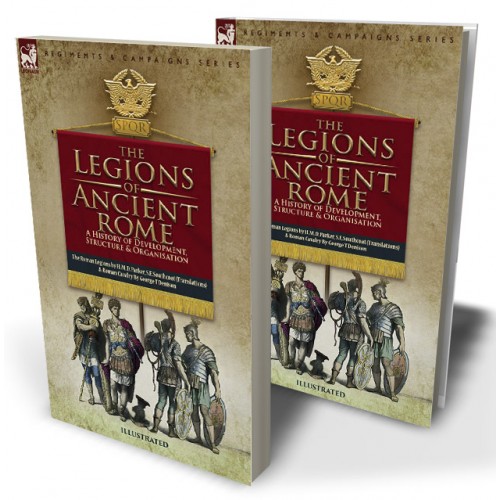
This book is a serious, erudite, academic in-depth examination on the legions of the ancient Roman Empire throughout the years of their development and existence. Accordingly, the text begins with the Marian Army Reforms and concludes in the post-Augustan Legion era circa 180 AD. The narrative also gives consideration to recruitment, the officer class, conditions of
service, arms together with orders of march and fighting. The original text, written a century ago, was intended for an academic readership and so included many passages presented in the source Latin. These have been, in this edition, translated into English for easier access for modern general readers. This edition has also been expanded by a short piece concerning the early development of ancient Roman Cavalry by Denison extracted from his work on the history of cavalry. Also included are several useful photographs and illustrations which
did not accompany the originally published texts.
Leonaur editions are newly typeset and are not facsimiles; each title is available in softcover and hardback with dustjacket.
The offensive armour, as described by Josephus, consisted of the pilum or throwing-spear, the gladius or Spanish sword, and the pugio or dagger slung on the left and right sides respectively. But in the second century, and perhaps as early as 69 A.D., some of the legionaries appear to have been armed with the lancea instead of the pilum. Arrian, in his order of battle against the Alani, shows that the legions were drawn up as a phalanx eight deep, and that the first four ranks were armed with the pilum and the four rear ranks with the lancea. On this occasion the front ranks were instructed not to throw their pila, but to use them for stabbing the horses of the attacking cavalry and unseating their riders, while the rear ranks were to hurl their lanceae over the heads of their comrades.
It would seem, therefore, that the lancea is a lighter kind of pilum, and this is confirmed by Isidorus, who says that it was a ‘hasta amentum habens in medio’, (‘a spear with a spearhead in the middle; for, if the amentum was intended to be used as a sling, it follows that the lancea must have been thrown, and not employed for thrusting as the hasta with which the auxiliaries were armed. The purpose of the innovation must, then, have been to give the legionaries on certain occasions a lighter throwing-spear, which, by the addition of the amentum, would both carry farther and with surer aim.
The advantage of such a new weapon is obvious when the phalanx was substituted, as in Arrian’s account, for the cohort formation; but a passage in Tacitus suggests that the lancea was not unknown in the first century, for he describes the Roman legionaries who fought against the Sarmatians as ‘miles facilis lorica et missili pilo aut lanceis adsultans, ubi res posceret, levi gladio inermem Sarmatam comminus fodiebat’, (‘The soldier, armed with a light breastplate and a missile, a spear or a spear, would attack the unarmed Sarmatian at close range with his light sword, whenever the situation required it’.)
This account may be contrasted with the speech put into the mouth of Suetonius Paulinus, in which he exhorts his troops ‘conferti tantum et pilis emissis, post umbonibus et gladiis stragem et caedem continuarent’, (‘They were only crowded together and, with their hair sticking out they continued the slaughter and slaughter with their spears and swords’). Here the pilum and gladius are the offensive weapons of the legionary infantry soldier, and the normal plan of attack is first to hurl the pila, and then rush in and decide the issue at close range with the glad. These are the weapons which distinguish the Roman legionary soldier not only from the Greek hoplite, but also from the Roman auxiliary, whose offensive weapons were the hasta or thrusting-spear and the spatha or long sword.
The method of advance of the Roman Army to the field of battle varied with the chances of attack from the enemy while the troops were on the march. If the country was known to be safe and there was little reason to suspect a sudden attack or ambush, the army proceeded in one long column. In the vanguard was an ala of auxiliary cavalry with its baggage; then followed the legions, each with its own baggage in rear; while the rear and flanks of the column were protected by more auxiliary cavalry. This was the normal formation employed by Caesar, and it is analogous to the order of march adopted by Vespasian in his invasion of Judaea, of which Josephus gives the following detailed account.

 your wishlist
 your account


 Click on image to enlarge
 Mouse over the image to zoom in