PAYMENT OPTIONS

​

Forthcoming titles

(Book titles are subject to change)

Air War: East Africa WW1

Raf Russia, 1940

The Asc In Africa

South African Gunners

The Supernatural Ludwig Tieck

Wellingtons Men

Shuttle Bury Cobb & Danby Croker

King William’s War

The Supernatural Jerome K. Jerome


1940: The B.E.F at War The Campaign in Northwest Europe and, ‘Operation Dynamo’, the Evacuation from Dunkirk

enlarge Click on image to enlarge
enlarge Mouse over the image to zoom in
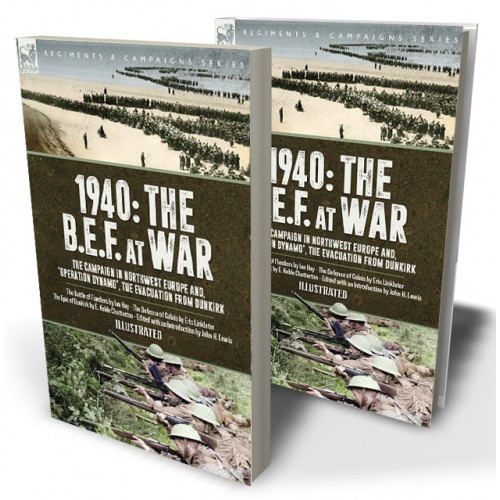
1940: The B.E.F at War The Campaign in Northwest Europe and, ‘Operation Dynamo’, the Evacuation from Dunkirk
Qty:     - OR -   Add to Wish List

Author(s): Ian Hay, Eric Linklater, E. Keble Chatterton & John H. Lewis
Date Published: 2026/06
Page Count: 204
Softcover ISBN-13: 978-1-918436-41-9
Hardcover ISBN-13: 978-1-918436-40-2

The Battle of Flanders by Ian Hay/The Defence of Calais by Eric Linklater/The Epic of Dunkirk by E. Keble Chatterton 
The epic story of one of the most outstanding episodes of the Second World War

As the Second World progressed in earnest in 1940 in the west, the British Expeditionary Force faced annihilation by the rapidly advancing German "Blitzkrieg". Defeated, the British began a desperate retreat to the Channel coast, made a heroic sacrificial stand at Calais, and was ultimately rescued by an incredible seaborne evacuation.The BEF had become trapped together with French forces in a pocket in northern France and Flanders. A counter-attack was  attempted, but failed. General Gort then ordered a fighting withdrawal toward the last available port, Dunkirk. Elements of the army were ordered to hold the port of Calais at all costs. Almost all of those British defenders were killed or captured, but their four-day defence successfully enabled the main army's escape. Codenamed, 'Operation Dynamo', the evacuation took place between 26 May and 4 June, involving a massive fleet of nearly a thousand vessels  These included naval destroyers and the legendary civilian little ships including pleasure craft, fishing boats, yachts, and lifeboats. Soldiers waded into the sea to be collected or boarded ships from the harbour mole that remained usable despite heavy bombing. Over 338,000 Allied soldiers were saved. This Leonaur edition-made possible by the release into the public domain of officially produced publications- contains three essential accounts that have been woven together to make a continual narrative of these momentous events.

Leonaur editions are newly typeset and are not facsimiles; each title is available in softcover and hardback with dustjacket.


The perimeter was held until dark, though by six o’clock there were breaches in it; the Germans, whose attack throughout was most resolute and searching, were filtering in from the south. This day-long defence of the outer line had protected the port of Calais from fire, and shipping could still use it. The Royal Navy, indeed, continued to use it for as long as there was reason, and motor-boats that had been built for idle days on the Solent came in and out of the shell-pocked, smoky harbour, bringing messages and removing wounded, with intrepid assurance.
When darkness fell the 60th, the Rifle Brigade, and detachments of Queen Victoria’s Rifles made a general retirement to the inner perimeter: a line, that is, enclosing the dock area, the old town, and the Petit Courgain. A Company of the 60th continued to hold its exposed position on the west of Fort Risban, and the Rifle Brigade were along the Canal de Calais and the Canal de Marck, on the old ramparts running north from the Porte de Marck and on the dunes.
A Company of Queen Victoria’s Rifles, which had been holding an eastward position near the original assembly area, had been out of touch all day with one of its platoons. The platoon was well forward, in an old redoubt with railway lines behind it and a canal on one flank. The Germans were on two sides of it, and sniping it from the canal bank and the bridge across the railway. The platoon appeared to be in a hopeless situation, but it held off the enemy’s attack till dark, and successfully withdrew. The men had had nothing to eat or drink, and they were very tired. But what finally compelled them to withdraw was lack of ammunition. They had fired their last round.
Just before midnight Nicholson was informed that a brigade group of the 48th Division had started that morning to march to his assistance. But nothing more was heard of this relief. Two brigades of the 48th Division were then in the neighbourhood of Dunkirk, but very weary. Not long after the arrival of this news—this vain hope—the direct line to London was cut.
During the night one of our destroyers entered the harbour, narrowly missed by shell-fire, and landed some ammunition. Admiral Somerville, who was on board, saw Nicholson and heard from him that during the two days of fighting a number of German tanks had been destroyed, and the enemy had taken fairly severe punishment. The Germans appeared, at the moment, to be short of ammunition. We also had had a good many casualties, and Nicholson emphasised his need of guns. He had two light anti-aircraft guns, and both two-inch and three-inch mortars; but he was desperately short of mortar ammunition.
The anti-tank guns had all been used singly to cover the main approaches. Half of them were out of action when the long perimeter was abandoned, and by Saturday morning only two remained. Their final positions were near the harbour.
Admiral Somerville reported that Nicholson was tired, but calm.
You may also like