PAYMENT OPTIONS

​

Forthcoming titles

(Book titles are subject to change)

Air War: East Africa WW1

Raf Russia, 1940

The Asc In Africa

South African Gunners

The Supernatural Ludwig Tieck

Wellingtons Men

Shuttle Bury Cobb & Danby Croker

King William’s War

The Supernatural Jerome K. Jerome


The Doctor John Thorndyke Mystery Novels: Volume 11 - The Jacob Street Mystery 31 New Inn (The novella which was later expanded into the novel The Mystery of 31 New Inn) and From the Diary of a Surgeon

enlarge Click on image to enlarge
enlarge Mouse over the image to zoom in
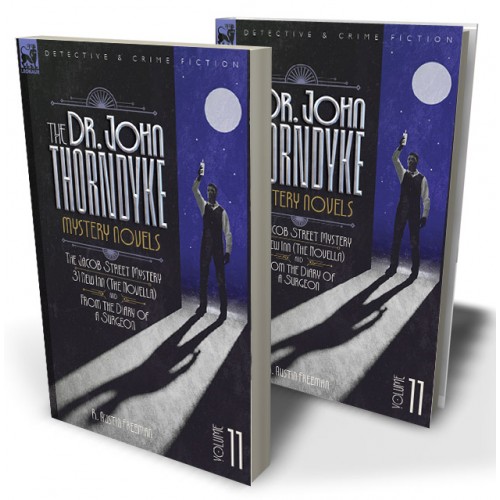
The Doctor John Thorndyke Mystery Novels: Volume 11 - The Jacob Street Mystery 31 New Inn (The novella which was later expanded into the novel The Mystery of 31 New Inn) and From the Diary of a Surgeon
Qty:     - OR -   Add to Wish List

Author(s): R. Austin Freeman & John Pitcairn
Date Published: 2026/06
Page Count: 364
Softcover ISBN-13: 978-1-918436-55-6
Hardcover ISBN-13: 978-1-918436-54-9

Volume 11 - A Final volume with six short stories featuring the medical mysteries of Dr. Wilkinson.

The author of this special Leonaur collection of the detective story novels, featuring Dr. John Thorndyke was, in fact, a physician himself, Dr. Richard Austin Freeman, (1862-1943). This eleven volume set of the longer stories of the 'Thorndyke' casebook has been introduced to complement the previously published Leonaur three volume collection of Thorndyke short stories. Shortly after Freeman qualified as a doctor, he volunteered for colonial service as a surgeon in West Africa and was involved in several dramatic incidents of the period. After he was invalided back to the UK he became a general medical practitioner, followed by a period in the Prison Service. Shortly afterwards his writing career accelerated until his literary output was, and remained for his entire life, prodigious. The first 'Thorndyke' story was published in 1907 and this Leonaur collection- featuring two novels per volume- has been collated chronologically. Although most modern readers are familiar with contemporary terms for the same activities, the pioneering Thorndyke is described as a medico-legal forensic investigator.Freeman's own background enabled him to ensure the scientific elements involved in his novels were authentic. Indeed, Freeman undertook verifying experiments to confirm their viability.Naturally, both Freeman and his most renowned character have become the focus of much attention by critics and enthusiasts of the detective fiction genre. Perhaps inevitably, comparisons, for several legitimate reasons, have been made to Sherlock Holmes. Some have observed that whilst Doyle was possibly the superior writer of entertaining tales,Thorndyke was-based on authentic science- the better detective. Be that as it may, readers may be assured that Thorndyke stories continue to be universally lauded as among the finest examples of the Edwardian detective fiction.

Volume eleven includes, ' The Jacob Street Mystery' together with ,'31 New Inn' which is the novella later expanded by Freeman into the novel, 'The Mystery of 31 New Inn. This final volume of this Leonaur also contains six entertaining stories which pre-date the Thorndyke series featuring Dr. Wilkinson, who is the prototype Thorndyke.

Leonaur editions are newly typeset and are not facsimiles; each title is available in softcover and hardback with dustjacket.
“Now,” said the sergeant, “we ought to see what that locket meant. Something must have happened, and it must have happened just about here; and I think it would be as well to lay down some sacks for the workers to stand on.”
This suggestion was adopted, and, when the sacks had been spread on the ground, the whole company of explorers concentrated on this region, clearing a broad track towards the tree and scrutinising each handful of leaves as it was removed. The ground thus uncovered still bore the imprints, faint and blurred, of the two pairs of feet, which continued evenly side by side until they had been traced to a point within a few yards of the tree. Then there was a sudden change in two respects.
No longer dim and faint, the footprints were now clear, sharp, and deeply impressed in the moist, clayey soil; and in place of the orderly, parallel lines, there appeared a confused welter of footprints pointing in all directions and overlapping and partially obliterating one another over a considerable area. From this a line of prints led in the direction of the tree, but although both pairs of feet could be distinguished, they were no longer side by side. Both led straight ahead and both had conspicuously deep toe-marks; but whereas the woman’s footprints were in some places trodden into, those of the man were all whole and undisturbed.
“Seem to tell their story pretty plainly, don’t they?” said the sergeant, viewing the whole group critically from his sack, and addressing Mr. Elmhurst.
“So it appears to me,” the latter replied. “My reading of them is that the couple walked together to this place, side by side and apparently quite amicably; then the man made a sudden attack and there was a struggle which ended in the woman escaping and running off, pursued by the man.”
“That’s about what it amounts to,” the sergeant agreed; “and now the question is, what was the next act? For the Lord’s sake be careful in uncovering the rest of the tracks.”
But the caution was unnecessary, for all the explorers were now on the tiptoe of expectation, and the position of the tracks being known, they were able to work from the sides and avoid the risk of treading on the prints.
“It is a bit of luck for us, sir,” the sergeant remarked to Blandy, “that the prints that matter most should happen to be the clearest. The ground here must have been uncovered at the time, and the leaves blown over it afterwards. I only hope the rest of the tracks will be as distinct.”.
“It’s of no great importance,” the inspector replied. “We know they were here, and we know who one of them was. The real question is, What has become of the woman?”
A couple of minutes later, that question seemed on the way to being answered; for, opposite the marked tree and extending several yards beyond it, was an area of heavily trampled ground on which the impressions of the two pairs of feet were so intermingled and confused that hardly a complete footprint was distinguishable. And the sergeant’s hopes were realised. The imprints had evidently been made on bare ground and the few that were whole were deep and remarkably distinct.
“Well, sir,” said the sergeant, “there seems to have been a pretty considerable dust-up. He didn’t have it all his own way. I wonder how—”
He did not finish the sentence, for the inspector was not listening. His sharp eye had apparently noticed something ahead, for after one long and intent look accompanied by the inevitable smile, he advanced over the uncleared leaves with a sack in either hand to a spot beyond the tree where the clearance was still in progress.
You may also like