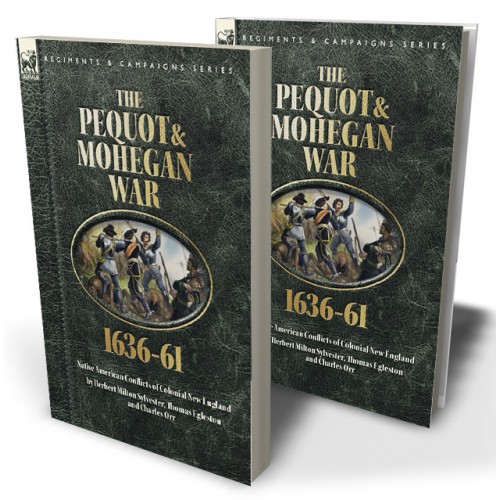
A 17th century conflict between English settlers and the Pequots of the Eastern seaboard
The Pequot War (1636–38) was a savage conflict in early colonial New England between the Pequot tribe and an alliance of English colonists from Massachusetts Bay, Plymouth, and Connecticut, supported by indigenous Mohegan and Narragansett tribes. The Pequots controlled the fur and wampum trade, leading to friction with English and Dutch settlers. The Mohegans, led by Uncas, were once part of the Pequot nation,but had acrimoniously separated, allying with the English. Whilst tensions simmered, the murders of two English traders provoked retaliatory raids which escalated to full warfare. Pequot warriors besieged Fort Saybrook throughout the winter of 1636–37. The war's most infamous event, however,was the Mystic Massacre (1637) when English forces under Captain Mason and Mohegan allies surrounded a fortified Pequot village and set it ablaze. Hundreds of Pequots, mostly non-combatants, were immolated, cut down or shot. Survivors fled but were defeated at bay in the Fairfield Swamp Fight. The Mohegans then became the most powerful tribe in the region. This book offers assessments of the conflict from three authoritative accounts of the subject.
Leonaur editions are newly typeset and are not facsimiles; each title is available in softcover and hardback with dustjacket.
Underhill’s story is that the conflict with these Pequots lasted an hour, with the final result that the Pequots were driven off with a loss of one hundred or more killed or wounded. Vincent records this episode, and DeForest intimates the former seemed to have a spite against Underhill. Vincent describes Underhill as a poltroon, and goes on to say that “after the discharge of five muskets, the Pequots took to their heels.” Underhill says—and his statement seems perfectly reasonable—that the Indians were very much astonished at the English manner of fighting. They called it “matchit,” or evil. As a method of fighting, for the Pequots, it was altogether too fast and furious, and, as well, too destructible.
The fashion of fighting among the savages was to obtain the advantage of an enemy by strategy, skulking, or surprise. The savage never fought in the open, unless he was possessed of overpowering numbers. His preference was the ambush. In the early years of the settlements this method of attack on the part of the savages was not taken with the degree of seriousness that it deserved; and after the English discovered the practice of his assailant, he began to adopt the same tactics, and the savage then saw the white man was no less wily and wary than himself. Once the English settler had learned the lesson, he was the superior of the Indian in the Indian’s method of fighting.
Mason kept to his retreat, but slowly, sending out skirmishers in advance, prodding every thicket and swamp, and firing bullets into their mystery for the purpose of dislodging their secret enemy should any happen to be lurking in ambush. The Pequots clung to the rear of this retreating body, and from behind rocks and trees, and such other shelter as lay in their path, they shot showers of ineffectual arrows. This pursuit was kept up by the Pequots until the English had come within perhaps two miles of the ships, when the former congregated in a body, and, after an apparent consultation, were lost to sight in the woods.
The English kept to their march shoreward, where they found their ships awaiting them, with Captain Patrick and forty men on board. Patrick did not reach Narragansett until after Mason’s departure overland. He found the ships and decided to take passage on them around to Pequot Harbor. Mason says his men would have joined Patrick on the vessels at once, had it not been for the objection of the Narragansetts to being left alone in the country of the Pequots. For that reason, only the wounded and thirty-five or forty others took ship, while Mason, with twenty men, and Patrick, with his forty, along with their Indian allies, set out through the woods for Saybrook.
On the line of their march was a little village belonging to the western Nehantics, the dwellers of which, suspicious of the purpose of the English, abandoned their village to hide in an adjacent swamp. The English followed them, pushed through the swamp, and drove them out on the opposite side, to lose them among the rolling ground or hillocks which lay beyond. The savages were so scattered that the pursuit was difficult; so, the English, coming together again, took up their march, and in the edge of dusk they made the mouth of the Connecticut. Their coming being made known, they were welcomed with a cannon salute from the fortress on the opposite shore.
Thus ended a long and arduous day for Mason and his men. A famous expedition, as well, in which the Connecticut settlers had been pitted against their natural enemy, was brought to a victorious close. It was an expedition, from many points of view, conducted with great courage, with perhaps more good luck than skill, but crowned with a most satisfactory success to the Connecticut settlers. It was hardly more than a massacre and indiscriminate killing of everything animate that had resemblance to a Pequot, from which escape seemed almost impossible, and in which an entire aboriginal community was condemned to a most horrible method of destruction.

 your wishlist
 your account


 Click on image to enlarge
 Mouse over the image to zoom in