PAYMENT OPTIONS

​

Forthcoming titles

(Book titles are subject to change)

Air War: East Africa WW1

Raf Russia, 1940

The Asc In Africa

South African Gunners

The Supernatural Ludwig Tieck

Wellingtons Men

Shuttle Bury Cobb & Danby Croker

King William’s War

The Supernatural Jerome K. Jerome


Lovewell’s War, 1722-25: New England Settlers in Conflict with the French Allied Wabanaki Indian Confederacy

enlarge Click on image to enlarge
enlarge Mouse over the image to zoom in
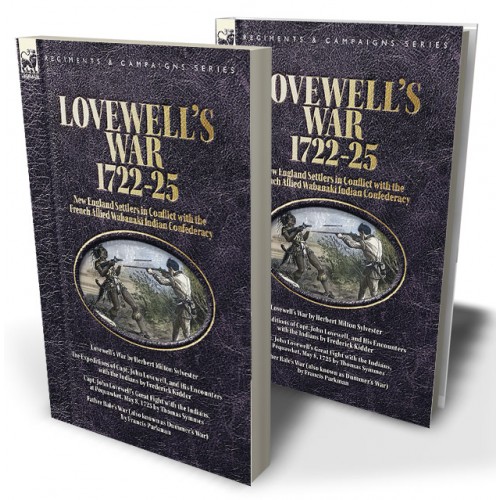
Lovewell’s War, 1722-25: New England Settlers in Conflict with the French Allied Wabanaki Indian Confederacy
Qty:     - OR -   Add to Wish List

Author(s): Herbert Milton Sylvester, Fredericj Kidder, Thomas Symmes & Francis Parkman
Date Published: 2026/08
Page Count: 160
Softcover ISBN-13: 978-1-918436-25-9
Hardcover ISBN-13: 978-1-918436-24-2

Lovewell’s War & The Expeditions of Capt. John Lovewell, and His Encounters with the Indians

Four comprehensive and essential accounts of an early conflict in Colonial American history

Lovewell's War (1722–25)—also known as Dummer's War or Father Rale's War—was, in reality, a series of conflicts fought between New England settlers and the Wabanaki Confederacy in present-day Maine and New Hampshire. It was primarily fought over land disputes and the inexorable impingement of expanding English settlements on indigenous Indian territory. The war is most famous for its final major engagement, The Battle of Pequawket or Lovewell’s Fight (May 1725). Captain John Lovewell led a private company of "scalp hunters" seeking bounties offered by the colonial government. Nearby Saco Pond (now Lovewell Pond) in Maine, Lovewell’s group was ambushed by the Abenaki Indians, led by Chief Paugus. Lovewell and Paugus were both killed during the day-long engagement. Only about 20 of Lovewell’s 46 men survived. Though a tactical draw, it forced the Abenaki to abandon their village and retreat to Canada, effectively ending major hostilities in the region. This Leonaur edition comprehensively considers this short war from several perspectives, providing a thorough overview for any student of the subject.

Leonaur editions are newly typeset and are not facsimiles; each title is available in softcover and hardback with dustjacket.


They had hardly crossed the Saco when two bands of Pequawkets who were returning from an expedition down river came upon their trail. One of these parties was under Paugus. At the head of the other was Wahwa. There were forty-one of the savages, and they were on their way to the lower village of this tribe, which was hardly more than a mile and a half from where the English had camped. Coming upon the trail of the English, they changed their purpose, and, taking the trail of the white men, which they were able to follow without difficulty, they planned an ambush by which they might trap them on their return.
As they had no knowledge of the number of their enemy, they were exceedingly wary; and it was only after nightfall that they approached the camp of Lovewell, if by chance they might satisfy themselves as to whether they might venture an open attack. The night was dark, and, unable to satisfy themselves as to the character and size of Lovewell’s force, they went into hiding, but not so far away but they might follow the movements of the English.
Lovewell’s men had left their packs behind, and once they were out of sight the savages were counting the packs, and in that way discovered Lovewell’s strength. The odds in their favor, they planned an ambush after removing and secreting the packs. The savage who had been after ducks, coming upon the English as he did, unwittingly was the cause of their doubling back on their trail, which precipitated the battle, and possibly saved the day for the survivors of Lovewell’s party.
The English got back to the place where they had left their packs, but the packs had disappeared. No sooner had this fact become apparent to them than the air shrilled with a riot of war-whoops of the Pequawkets, who swarmed upon them from behind the huge trees where the savages had been patiently awaiting the return for their baggage. With the Dunstable men it was now a fight to the death. The Indians emptied their guns as they broke from their coverts. As they bore down upon the English, it is evident they expected to stampede the latter; but the English took to the shelter of the trunks of the trees to fight their foe after the aboriginal fashion, but not before the fatal bullet had sped its way to Lovewell.
You may also like