An erudite assessment of a pivotal period of military development
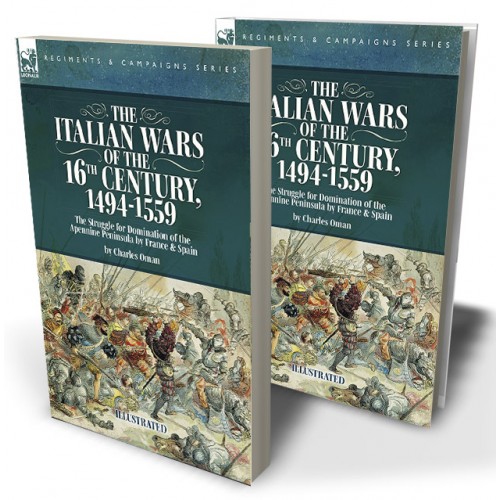
This book's contents have been extracted from Oman's very substantial work covering the principal conflicts fought during the turbulent 16th century. There can be little doubt that this author- in common with his contemporary academic, Sir John Fortescue- was one of the finest and most accessible historians Britain has produced. The Italian Wars (1494–1559) were prosecuted for the control of the Italian peninsula, then comprised of a number of smaller states, as part on an ongoing struggle for dominance in the region between France and Spain. This was a time of innovation in weaponry and tactics in the European theatre which would fundamentally modernise warfare. Gunpowder, firearms, and advanced fortifications were widely adopted. In typical style,Oman expertly and readably guides the reader through an overview of these complex geopolitical affairs and explains the principal engagements accompanied by clear diagrams of the respective battles. The various kinds of soldiers engaged are also described in some depth, including the application of weapons employed upon these Renaissance fields of conflict. This Leonaur edition includes further illustrations which were not present in the original edition. Recommended for all students of the period and those who have enjoyed the well- known and highly regarded autobiographical writings of Blaise de Monluc.
Leonaur editions are newly typeset and are not facsimiles; each title is available in softcover and hardback with dustjacket.
But Montmorency might as well have stayed behind, for when he had conducted the column up to near gunshot of the enemy, and bade the Swiss halt, to allow time to bring up the artillery, who were to batter the Imperialist entrenchments—as at Ravenna in 1512—he met with frank disobedience. The pikemen did not stop. Possibly the Swiss captains noted the way in which the Imperialist guns were entrenched and embrasured, and doubted the efficiency of artillery preparations. But it is more likely that (as French observers stated) they were inspired by blind pugnacity and self-confidence.
At any rate they rushed straight at the Imperialist position: we are told that the two columns were in rivalry with each other—the one consisted of the contingents of the old rural cantons, under the command of Arnold Winkelried of Unterwalden, the other of troops of Bern and other urban cantons, under Albert von Stein—the captain who never forgave himself for having been a day late at Novara, and who had marched off before the battle at Marignano. The moment that the columns came in range of Colonna’s guns they began to suffer heavily—the ground being level irrigated fields, and the distances having been marked out by the enemy’s master-gunners.
A thousand Confederates are said to have fallen before they reached the hollow road—and then they came to a dead stop—for the obstruction was so deep, and the rampart behind it so high, that the head of a pike could hardly be stretched from the bottom of the ditch to the crest of the earthwork. And as its sides were cut perpendicularly, there was great difficulty in scrambling up the smooth face.
When the heads of the columns jumped down into the ditch, they were received by four successive volleys from Pescara’s Spanish arquebusiers; it is said that all the standards went down, and that the three or four first ranks perished wholesale. But this did not quite check the onset: the Swiss were heard calling for the officers and double-pay men to come to the front, and the summons was not in vain. There was a desperate attempt to break into the position, and in several places, groups, scrambling up over the dead and wounded, did reach the top of the rampart. But they were at once charged and tumbled back into the ditch by the German and Spanish pikemen, who came up through the arquebusiers.
It is said that Arnold Winkelried, the captain of Unterwalden, (Giovio says that Albert von Stein was the Swiss who fought him, it was perhaps Winkelried’s desperate charge on this occasion which got his name into the legend of Sempach, as a man who sacrificed himself for his followers), and George Fründsberg, the landsknecht leader, actually met hand to hand, and that the former was laid low by the German’s pike, and the latter wounded in the thigh by the Swiss halberd.
Almost all the French nobles who had volunteered to serve in the assault were killed: only Montmorency was dragged half dead out of the ditch by a faithful friend. After spending half an hour in desperate attempts to get forward, the survivors of the two columns turned back and retreated in a slow and sullen fashion—as at Marignano—to the ground from which they had started. They left before the rampart in the ditch, and on the field which they had first crossed, over 3,000 dead, including 22 captains, among whom were both Winkelried and Albert von Stein, who had led the Bernese column.

 your wishlist
 your account


 Click on image to enlarge
 Mouse over the image to zoom in