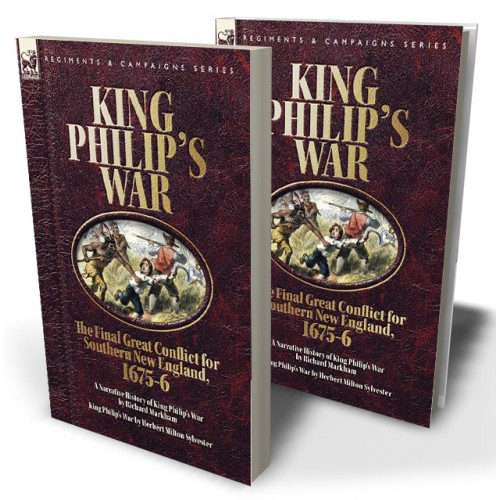
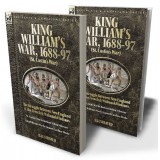
A Narrative History of King Philip’s War & King Philip’s War
Without doubt one of the most brutal wars fought in the early years of the European settlement of North America, the so called,'King Philips' War' remains a stain on the behaviour of the English colonists in New England as they struggled with its indigenous Native Indian tribes for dominance of the region. Predictably, the war broke out as a consequence of rapid land expansion by the avaricious new comers. The English forced legal jurisdiction over Native peoples at the cost of their own traditional sovereignty, which brought tensions to boiling point. The war takes its name from the principal leader of Indian resistance,the Wampanoag tribe chief, Metacomet (known to the English as King Philip). This conflict was especially ferocious with barbaric outrages committed on both sides. A dozen frontier towns were destroyed as a confederation Metacomet,Nipmuc, Podunk, and Narragansett tribes, launched effective guerrilla raids on English settlements throughout the region. However,'The Great Swamp Fight', killed hundreds of Narragansett people and starvation followed, prisoners were sold into slavery in the West Indies or Spain.. The Mohegan and Mohawk tribes sided with the colonists, but overall, the regional Native population fell by over a half. This book contains two perspectives of this terrible time and contains many eyewitness accounts.
Leonaur editions are newly typeset and are not facsimiles; each title is available in softcover and hardback with dustjacket.
Some three days after, Captain Lathrop, with eighty men, besides the teamsters and carts, went over to Deerfield to thresh the grain and convey it to headquarters. The savages let them alone until they made ready to return. They got as far as Bloody Brook, when they were attacked by “seven or eight hundred Indians, whereby himself and most of his soldiers, to the Number of seventy-three were cut off.” Before this, there had been signs of uneasiness among the Narragansetts. The Nipmucks had not fully decided to join fortunes with Philip, and the latter part of this month of July, Captain Hutchinson of Boston, with Captain Wheeler of Concord, and a small party of soldiers, were despatched to Quaboag to negotiate a treaty with the Nipmucks.
They reached Brookfield on a Sunday. There were no Indians there to meet them. They sent out scouts to discover their whereabouts, and, meeting some of the Nipmuck chiefs, these latter promised to meet the English at Wickabaug Pond, near Brookfield. The savages did not come, and Hutchinson, breaking camp again, kept on toward the Mominimisset settlement. Here on one side of the trail was a jungle of swamp-lands. On the other side was a perpendicular wall of earth and rock. Hardly had Hutchinson and his party entered this narrow defile than they were attacked by two or three hundred Indians. Eight of the English were killed outright. Both Hutchinson and Wheeler were wounded, with three others. They made their escape from this ambuscade, entering the town, to which the savages had set fire in several places.
All the houses were soon in ashes, except such as the Indians had reserved for their own accommodations, and one other of some considerable size, in which the settlers and soldiers had taken refuge. This was attacked, and for a space of two days the savages pelted it with lead. Combustibles were heaped against its walls; wads of cloth saturated with inflammable matter were fastened to arrows and shot upon the roof; but their efforts were still abortive. Finally, heaping a cart with hay and straw, they pushed it against the building and, setting it aflame, had no better success; for a heavy shower of rain passed over the town at the critical moment. Within were seventy men, women, and children; while without, a horde of painted devils were making the day hideous with their noisy antics. Escape seemed impossible.
Of the two messengers who got away undiscovered, only one reached Boston safely. He told a story of peril that sent a party of forty-six men and five Indians, under Major Willard and Captain Parker, to Brookfield. They came in on the evening of August 4, just in time to divert the savages from a sure conquest. They engaged the savages at once in a fight that lasted through most of that night. As the dawn came, the Indians burned the remaining house and made for a swamp a few miles away, where they joined Philip, who had there gathered the remnants of his tribe about him. The Indians, in this Brookfield fight, were severely punished, with a loss of some eighty warriors killed and wounded.

 your wishlist
 your account


 Click on image to enlarge
 Mouse over the image to zoom in