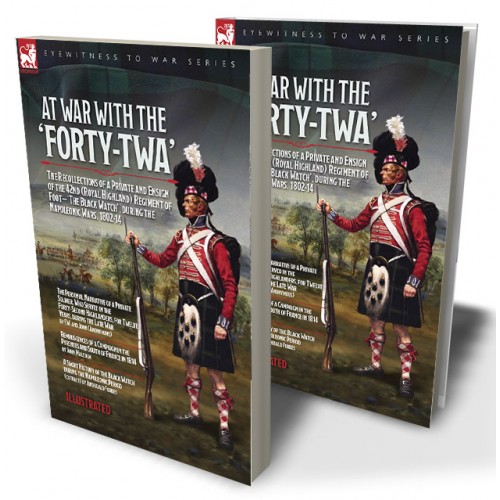
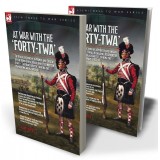
At War with the ‘Forty-Twa’ - The Recollections of a Private and Ensign of the 42nd (Royal Highland) Regiment of Foot—‘The Black Watch’, during the Napoleonic Wars, 1802-14
The Personal Narrative of a Private Soldier, Who Served in the Forty-Second Highlanders, for Twelve Years, during the Late War,
Reminiscences of a Campaign in the Pyrenees and South of France in 1814 and A Short History of the Black Watch during the Napoleonic Period (extract)
Two eye-witness accounts from the Highlanders at Walcheren and the Peninsular War
This Leonaur edition of a private soldier's first-hand experiences during the Napoleonic Wars is without doubt one of the finest books of its kind. 'John' -for that is all we are told of his identity-, recounts his story in an immediate and highly detailed style which carries the reader into the life of a regular Scottish infantry soldier in the British Army of the day. The memoir recounts his 12-year service after he recklessly enlists in the famous 42nd (Royal Highland) Regiment of Foot - The Black Watch. His service-which is one of dogged survival- spanned the Peninsular War, as the author served under both Moore and Wellington. 'John' was also deployed to the Netherlands for the infamous Walcheren Expedition, during and after which hundreds of soldiers died of disease, rather than in combat. The principal theatre of war in his account concerns the campaigns against Napoleon's forces in Spain and Portugal and it includes stark descriptions of deprivation and perpetual foraging for food, enduring severe weather, harsh military discipline and sackings of cities following siege assaults. This is military history told from the sharpest end of conflict as this veteran recounts the battlefields at Corunna, Salamanca, Burgos, Vittoria, The Pyrenees and Toulouse. The second account by, Ensign John Malcolm provides a companion view of many of the same events during the later stages of the campaign from the perspective of a young officer. This edition also includes a history of the 42nd Foot on campaign during this period by Forbes, for context. Contains illustrations and maps not included in original editions.
Leonaur editions are newly typeset and are not facsimiles; each title is available in softcover and hardback with dustjacket.
Meantime, our division (the 6th) approached the foot of the ridge of heights, on the enemy’s right, and moved in a direction parallel to them, until we should reach the point of attack. We advanced along the foot of the ridge, under a heavy cannonade, from some redoubts on the heights. At one part of the ground over which we passed, many of the shot took effect; and a soldier, immediately before me, was struck by a cannon ball, about the middle of the body, and fell a frightful and shapeless mass, scarcely retaining a trace of humanity.
We arrived, at last, immediately in front of a redoubt, which protected the right of the enemy’s position, where we were formed in two lines—the first consisting of some Portuguese regiments, and the reserve, at this point, of the Highland brigade. Darkening the whole hill, flanked by clouds of cavalry, and covered by the fire of their redoubt, the enemy came down upon us like a torrent; their generals and field-officers riding in front, and waving their hats amidst shouts of the multitude, resembling the roar of an ocean.
Our Highlanders, as if actuated by one instinctive impulse, took off their bonnets, and waving them in the air, returned their greeting with three cheers. A deathlike silence ensued for some moments, and we could observe a visible pause in the advance of the enemy. At that moment, the light company of the 42nd regiment, by a well-directed fire, brought down some of the French officers of distinction, as they rode in front of their respective corps. The enemy immediately fired a volley into our lines, and advanced upon us, amidst a deafening roar of musketry and artillery.
Our troops answered their fire only once, and, unappalled by their furious onset, advanced up the hill, and met them at the charge. Our bayonets, however, pierced nothing but wreaths of smoke; for, our foes having suddenly changed their minds, were charging in the opposite direction: and just such a glimpse did we obtain of them, vanishing over the ridge of the hill, as did Geoffry Crayon of “the stout gentleman.” Upon reaching the summit of the ridge of heights, the redoubt which had covered their advance fell into our possession; but they still retained four others, with their connecting lines of entrenchments, upon the level of the same height on which we were now established, and into which they had retired.
Meantime, our troops were drawn up along a road, which passed over the hill, and which, having a high bank at each side, protected us in some measure from the general fire of their last line of redoubts.
Here our brigade remained a considerable time, until Marshal Beresford’s artillery, which, in consequence of the badness of the roads, had been left in the village of Mont Blanc, could be brought up; and, until the Spaniards, under Don Manuel Freyre, could be re-formed, and brought back to the attack.
During this pause, we were ordered to sit down along the sides of the road, the embankments of which afforded us protection from the point-blank shot of the redoubts and fortified houses into which the enemy had retired, but not from their shells, which they threw among us with great precision, and by which we lost a good many men; and latterly they moved round some guns to a position, from which the line of the road was completely raked by their fire. During this period of the battle, General Pack sat on horseback in the middle of the road, showing an example of the most undaunted bravery to the troops.
I think I see him now, as he then appeared, perfectly calm and unmoved, and with a placid smile upon his face amidst a perfect storm of shot and shells. His aide-de-camp, Le Strange, who was afterwards killed at Waterloo, had his horse shot under him, and both came down together. A few minutes afterwards, I observed General Pack suddenly turn pale, and seem as if going to faint. This was occasioned by a ball which had passed through his leg. He rode slowly to the rear, where he had his wound dressed, and in a few minutes returned again.

 your wishlist
 your account


 Click on image to enlarge
 Mouse over the image to zoom in