PAYMENT OPTIONS

​

Forthcoming titles

(Book titles are subject to change)

Air War: East Africa WW1

Raf Russia, 1940

The Asc In Africa

South African Gunners

The Supernatural Ludwig Tieck

Wellingtons Men

Shuttle Bury Cobb & Danby Croker

King William’s War

The Supernatural Jerome K. Jerome


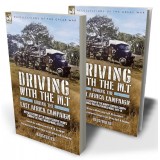
Driving with the M.T during the East Africa Campaign - Recollections of the Army Service Corps during the First World War

enlarge Click on image to enlarge
enlarge Mouse over the image to zoom in
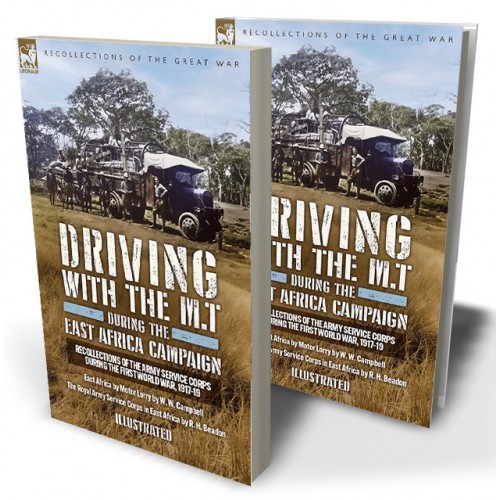
Driving with the M.T during the East Africa Campaign - Recollections of the Army Service Corps during the First World War
Qty:     - OR -   Add to Wish List

Author(s): W. W. Campbell & R. H. Beadon
Date Published: 2026/10
Page Count: 236
Softcover ISBN-13: 978-1-918436-75-4
Hardcover ISBN-13: 978-1-918436-74-7

East Africa by Motor Lorry & The Royal Army Service Corps in East Africa

Behind the wheel in the East African Bush

In this unusual first-hand account from one of the side-show theatres of the First World War, William Wallace Campbell recounts his experiences serving in the East African campaign as a driver for the British Army Service Corps Mechanical Transport division. Unlike the stalemate of the Wester Front, the East African campaign was a mobile conflict fought primarily between British Imperial forces and German colonial troops led by the talented,General von Lettow-Vorbeck. This war's stage was the vast terrain of German and Portuguese East Africa at a time when it was virtually all bush. This meant that logistical motor transport for the army was problematic in every way. Campbell's account encompasses the period from 19 November 1917 to 11 February 1919, and describes how these drivers transported wounded soldiers and critical supplies as this 'hit and run' conflict progressed  through a treacherous wilderness of rough tracks, mud, and rivers .Campbell writes compellingly and thrillingly about encounters with local wildlife, ( frequently lions) which were as significant a danger as ambushes by German askaris. Interactions with indigenous people, who had to that point seen little of the modern world, are also fascinating. However, as with all campaigns in tropical climes, disease regularly thinned the ranks more reliably than bullets. This Leonaur edition is accompanied by a thorough  overview of the activities of the RASC in WW1, East Africa by Beadon, for context. Contains illustrations and photographs.

Leonaur editions are newly typeset and are not facsimiles; each title is available in softcover and hardback with dustjacket.


The military situation during the latter part of July and early August gave the gravest concern to all British troops on the Mozambique line. After his great success at Kilimane, and the routing of the troops sent down against him through the forest, Von Lettow succeeded in subjugating the garrison at Namirrue.
After this he took a rest for several days. He then started on his anticipated march to Monapo. It was then that all the alarm took place and Lumbo dug trenches and put up barbed-wire defences. He got one-third of the way, whereupon, doughty man as he was, he realised the hopelessness of the task before him.
Scattered British troops were re-forming and closing in upon him. Monapo and Lumbo were too dangerously near the coast, well held, and in the apex of a triangle, and, tempting as the project was, it was too daring. He turned on his tracks and retreated, with the same methodical thoroughness as he had advanced. For two hundred miles into the west, far into the wilds of Portuguese East, he retired by forced marches.
When the news of his disappearance reached us, we again lapsed into that phase of stagnation that always followed the disappearance of Von Lettow. Excitement died down, work slackened off, and everybody began to look at everybody else as if asking, ‘‘Well, what’s to be done now?” And nobody knew. . . .
On resuming my duties in the office, I found that owing to depletion in the ranks due to illness we were very much behind in our work. It was not always fever or the sun that sent men into hospital. Corporal Marmot and Pye, two of our company, were both in hospital with poisoned feet caused by jiggers. The jigger is a flea-like insect that lives in the sand. She, for it is the female that causes all the trouble (as usual, from some points of view), gets into your boot, or at any rate gets on to the foot, burrows into a tender part, usually under the nail of the big toe, and there deposits her eggs. Irritation and inflammation set in; then, discovering what’s the matter, you engage a native—see that he is skilled to the work—and, with the help of a needle (not a rusty one), he extracts the bag of eggs.
If the operation is unskilful and the bag is broken, then look out for trouble, and septic poisoning, which might result in the loss of the toe-nail, the toe, or even the foot. I had often heard the expression, “Well, I’m jiggered!” but never thought it would apply to me! I had no less than eight taken out of one foot in twenty-four hours, all carefully extracted.
You may also like