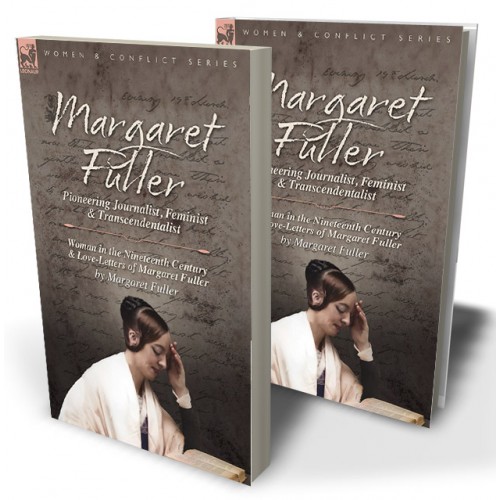
'Woman in the Nineteenth Century' and 'Love-Letters of Margaret Fuller'
The inspirational writing of an exceptional American feminist intellectual
Margaret Fuller was a pioneering American journalist, critic, philosopher, and women's rights advocate. She is widely regarded as a prominent intellectual and a foundational figure of American feminism. Born in Cambridgeport, Massachusetts in 1810, Fuller was comprehensively educated by her father, Timothy Fuller, until she became fluent in Latin, Greek, French, German, and Italian. She was befriended by Ralph Waldo Emerson, Henry David Thoreau, and Elizabeth Peabody among others and hosted discussions for women to promote intellectual self-reliance. At Emerson's request, she became the first editor of the Transcendentalist journal, 'The Dial', becoming a notable critic which led to an appointment as Literary Critic for the New-York Tribune, and later a front-page columnist tackling social reforms. In 1846, Fuller became the first American female foreign war correspondent, reporting on the Italian revolutions of 1848. Her seminal work and the highly regarded, principal work in this edition was .'Woman in the Nineteenth Century' written in 1845. This was an expansion of her 1843 essay, and is regarded as the first American feminist treatise of note, proposing political, economic, and intellectual equality for women at a time when the concept was widely unconscionable in wider society. Whilst in Italy, Fuller met and subsequently married the Italian revolutionary Giovanni Ossoli. They had a son, Angelo. In 1850, the family sailed for America, but their ship was wrecked close to the shore of Fire Island, New York and the entire family were tragically drowned. This Leonaur edition also includes some of Fullers romantic correspondence.
Leonaur editions are newly typeset and are not facsimiles; each title is available in softcover and hardback with dustjacket.

Another sign of the times is furnished by the triumphs of female authorship. These have been great and constantly increasing. Women have taken possession of so many provinces for which men had pronounced them unfit, that though these still declare there are some inaccessible to them, it is difficult to say just where they must stop.
The shining names of famous women have cast light upon the path of the sex, and many obstructions have been removed. When a Montague could learn better than her brother, and use her lore afterward to such purpose, as an observer, it seemed amiss to hinder woman from preparing themselves to see, or from seeing all they could, when prepared. Since Somerville has achieved so much, will any young girl be prevented from seeking a knowledge of the physical sciences, if she wishes it? De Stael’s name was not so clear of offence; she could not forget the woman in the thought; while she was instructing you as a mind, she wished to be admired as a woman; sentimental tears often dimmed the eagle glance.
Her intellect too, with all its splendour, trained in a drawing-room, fed on flattery, was tainted and flawed; yet its beams make the obscurest schoolhouse in New-England warmer and lighter to the little rugged girls, who are gathered together on its wooden bench. They may never through life hear her name, but she is not the less their benefactress.
The influence has been such, that the aim certainly is, now, in arranging school instruction for girls, to give them as fair a field as boys. As yet, indeed, these arrangements are made with little judgment or reflection; just as the tutors of Lady Jane Grey, and other distinguished women of her time, taught them Latin and Greek, because they knew nothing else themselves, so now the improvement in the education of girls is to be made by giving them young men as teachers, who only teach what has been taught themselves at college, while methods and topics need revision for these new subjects, which could better be made by those who had experienced the same wants.
Women are, often, at the head of these institutions, but they have, as yet, seldom been thinking women, capable to organise a new whole for the wants of the time, and choose persons to officiate in the departments. And when some portion of instruction is got of a good sort from the school, the far greater proportion which is infused from the general atmosphere of society contradicts its purport. Yet books and a little elementary instruction are not furnished, in vain. Women are better aware how great and rich the universe is, not so easily blinded by narrowness or partial views of a home circle.
“Her mother did so before her,” is no longer a sufficient excuse. Indeed, it was never received as an excuse to mitigate the severity of censure, but was adduced as a reason, rather, why there should be no effort made for reformation.
Whether much or little has been done or will be done, whether women will add to the talent of narration, the power of systematising, whether they will carve marble, as well as draw and paint, is not important. But that it should be acknowledged that they have intellect which needs developing, that they should not be considered complete, if beings of affection and habit alone, is important.