Author(s):
Hubert Griffith, D. Richards & H. St. George Saunders Date Published:
2026/10 Page Count:
132 Softcover ISBN-13:
978-1-918436-79-2 Hardcover ISBN-13:
978-1-918436-78-5
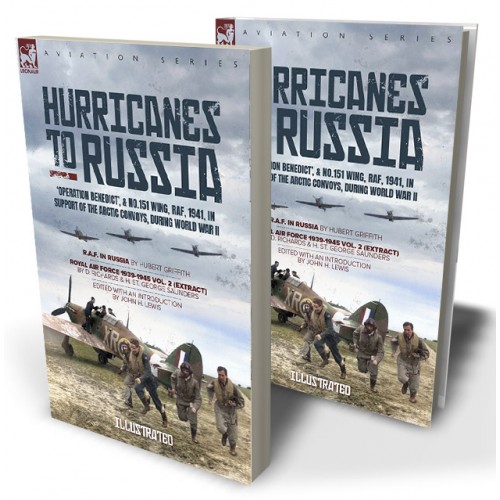
'R.A.F. in Russia' & 'Royal Air Force 1939-1945 vol. 2 (Extract)'
An extraordinary RAF and Soviet cooperation in wartime
In the opening stages of the Second World War in Europe, as Russia became an British Ally, it was considered vital to both protect the strategic port of Murmansk from air attacks upon arriving maritime supply convoys and also to train Soviet pilots on British fighter aircraft. The RAF created No. 151 Wing, comprised of two fighter squadrons: No. 81 Squadron and No. 134 Squadron. The unit flew Hawker Hurricane Mk IIB fighters. A total of 39 Hurricanes were initially delivered to the Russian forces—some arriving in crates via the first Arctic Convoy (Operation Dervish) and assembled on-site, while 24 were flown directly to their new bases and owners from the aircraft carrier HMS Argus. Once established, operations by RAF pilots were undertaken from Vaenga airfield, inside the Arctic Circle. Within five weeks of active operational sorties, 151 Wing claimed 16 Axis aircraft destroyed, 4 probables, and 7 damaged. They suffered minimal casualties with just one pilot lost together with two ground crew killed in an accident. As winter approached the British pilots had trained their Soviet counterparts to fly and maintain the Hurricanes and by the close of the year, the RAF personnel were evacuated back to Britain. The principal work in this Leonaur edition was written by an officer present with the expedition and is supported by an overview introduction and an extract from the official history which places the activities of 151 in the broader context of this theatre of the early period of the war.
Leonaur editions are newly typeset and are not facsimiles; each title is available in softcover and hardback with dustjacket.

September 11th onwards
A steady routine was now settled down to—or perhaps “comparatively steady routine” would be a more descriptive phrase; for in an operational camp, on foreign soil, in the autumn Arctic, making first contact with new Allies, so much was strange, unexpected, impromptu, and not-covered-by-any-known-procedure—that each day had the quality of being strikingly different. from its predecessors in at least one or other important respect. Problems arose. Problems were settled. But at least, except towards the very end of the stay, nobody could complain of lack of variety.
There will be inevitable questions asked:—What did the Wing eat?—What were its quarters?—What did its camp look like?—How did it communicate, if at all, with its Soviet opposite numbers?—Was life a round of gaiety, or the bleakness of desolation?—Was the Russian mode of Air-Force life more like our own, or less like our own? How, in short, did Anglo-Soviet collaboration proceed in the northern solitudes?
Extracts from various Wing day-to-day journals may give a hint of it. If one factor alone survives—that contact with our Ally was intimate, constant, generous on their side, and fruitful in results achieved and for future results to come, then the main point will have emerged clear.
September 12th
First fully operational day, as recounted already. Our score: three certain, one probable, one damaged. Loss:—one pilot killed. Many. alerts; several Huns over the camp. No bombs dropped.
September 14th
Dull day. Hardly any flying. Funeral of Sergt.-Pulot in “Cemetery of Soviet Heroes,” on high ground overlooking Murmansk Sound. We sent a firing-party; the Russians sent a firing-party. The Russians had also, unasked, made and dyed the British White Ensign, and the coffin was carried through the village and up to the grave with the British Ensign and the flag of the Soviet Fleet Air-Arm draped side by side over it. The English Funeral Service was read by F/Lt. Fisher. A quiet and curiously impressive ceremony of the first British casualty on Soviet soil.
September 14th
“Two patrols—nil engagements, nil causalities.” Another funeral—this time of a Russian air-ace and a Soviet Sergt.-Pilot. The Wing sent a firing-party, and our commanding-officer and some of his officers attended. The local brass-band turned out and played Chopin’s Funeral March. The occasion was made a political one, with speeches at the grave-side, lasting from 5 o’clock till long after dark, a matter of nearly three hours. Impressive—in a different way.
Back in the Mess. F/Lt. Michael Rook (cousin to S/Ldr. Rook) had been testing his Hurricane. Asked if he had made a good landing:—“Perfect, old boy! Put her down as light as a gnat’s whisker!. . .” Seeing that a twelve-gun Hurricane weighs nearly four and a half tons, the phrase had great verbal charm, if some exaggeration.
Dozens of fresh eggs have appeared in the Mess, served, fried, in plates of three. Michael Rook eats three, then is pressed by the Russian waitresses to take another plate of three, and complies. Then is pressed to take another three, but declines:—“I can eat a Flight, but not a Squadron. . . .”
September 17th