PAYMENT OPTIONS

​

Forthcoming titles

(Book titles are subject to change)

Air War: East Africa WW1

Raf Russia, 1940

The Asc In Africa

South African Gunners

The Supernatural Ludwig Tieck

Wellingtons Men

Shuttle Bury Cobb & Danby Croker

King William’s War

The Supernatural Jerome K. Jerome


King William’s War, 1688-97 (St. Castin’s War) - The Struggle between New England and the French and Wabanaki Indians

enlarge Click on image to enlarge
enlarge Mouse over the image to zoom in
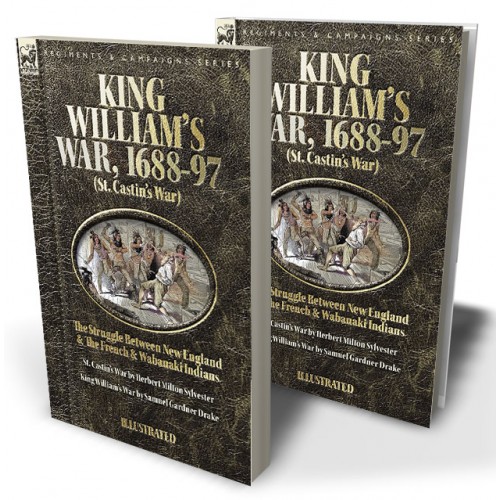
King William’s War, 1688-97 (St. Castin’s War) - The Struggle between New England and the French and Wabanaki Indians
Qty:     - OR -   Add to Wish List

Author(s): Herbert Milton Sylvester & Samuel Gardner Drake
Date Published: 2026/10
Page Count: 160
Softcover ISBN-13: 978-1-918436-69-3
Hardcover ISBN-13: 978-1-918436-68-6

'St. Castin’s War' & 'King William’s War'

King William's War, (1688–1697) was a 17th century American colonial-era,border conflict fought in Acadia and New England. It was colloquially named after one of the principal antagonist leaders, Jean-Vincent d'Abbadie de Saint-Castin, a French military officer who married a woman of  the Penobscot  Native-American Indian Nation. In 1688, The authoritarian colonial  Governor of New England, Edmund Andros raided Saint-Castin’s trading estate at Pentagouet (modern-day Castine, Maine) in his absence, comprehensively plundering it. This violent act naturally raised Saint-Castin's anger, so when in the following year, the 'Nine Years War', broke out in Europe a political motivation was created which endorsed this personal grudge. The French, whose expansionist policies had started the war in Europe, encouraged Saint-Castin to set lose his indigenous allies among the Wabanaki Confederacy upon the borders of the English settlements. Saint-Castin, in concert with the Penobscot Chief, Madockawando instituted savage guerilla assaults upon against English outposts along the Maine frontier.Working alongside French commander Pierre Le Moyne d'Iberville, Saint-Castin’s forces successfully besieged and destroyed the heavily fortified English stronghold of Fort Pemaquid.  Saint-Castin became a wanted man with several attempts made to apprehend him. The Treaty of Ryswick ended all hostilities in a stalemate, boundaries were re-established but long held animosities remained. 

Leonaur editions are newly typeset and are not facsimiles; each title is available in softcover and hardback with dustjacket.

For all this suggestion of warmth and hospitality, the savages kept the shadow of the great hill, without fires, exposed to the smother of a blinding snow-storm that began before daybreak. Chilled to the bone, and greedy for the heats of burning cabins, they broke camp with the dawn. Around the savages was the silent wilderness; before, was the sleeping settlement.
York was a considerable settlement and locally prominent in the province. The relict of old Gorgeana, from its earliest days it possessed a reputation for stability, with numerous families of pretension, from Godfrey down. It was morning on the fourth day of February, 1692. All over York the snow was piled in deep drifts. It had been a severe winter. The sea lay before, dusky and blurred under the storm. Over the cleared lands the snow sifted down, choking the rim of the woodlands with its blinding smother. To the settler the deepening cold had been pregnant with safety, and York, unheeding, slept.
A lad had gone out early into the woods, possibly to look after his traps. Making his way stealthily through the snow-laden bushes, he came upon a stack of snow-shoes. Any boy in York can point out Snow-shoe Rock; for it was in the lee of a boulder young Bragdon came upon this strange accumulation. A glance revealed their like strange fashioning. Retracing his way, he sped toward Indian Head as the nearest hiding-place. Gaining that shelter, while getting his wind for another spurt, he observed an Indian dog nosing at his heels. The animal’s muzzle was bound with deer-thongs.
With a new terror tugging at his heart, Bragdon fled toward the river, the dog still at his heels. He found a boat, in which he crossed the stream, and, stumbling into the cabin of a settler named Smith, fell across the threshold, the breathless tale on his lips. A musket-shot verified his story, and the butchery of the half-dressed settlers of old York began. Parson Dummer was shot at his door. (Rev. Shubael Dummer, the first settled minister of York. He married a daughter of Edward Rishworth. Bourne says he was eminent for his social virtues and his moral and mental culture.)
A hundred settlers had been shot and tomahawked when this massacre was over. Eighty had been made captive. One or two of the garrison-houses were taken, but such of the settlers as gained those of Preble, Harmon, Alcock, and Norton escaped, as the savages avoided their muskets. Killing all the cattle, and loading themselves with plunder, under the low-drifting smokes of the burning settlement the marauders divided into small parties to scour the country five miles around. All the outlying farms having been laid waste, they made off into the woods on their return journey to Pentagoët, and York was left to count her dead and brood over her broken families. (Parkman regards the account of Champigny, in a letter to the minister. October 5, 1692, as the best of the attack on York.)
A force of men from Portsmouth followed the trail of this party.
You may also like