PAYMENT OPTIONS

​

Forthcoming titles

(Book titles are subject to change)

Air War: East Africa WW1

Raf Russia, 1940

The Asc In Africa

South African Gunners

The Supernatural Ludwig Tieck

Wellingtons Men

Shuttle Bury Cobb & Danby Croker

King William’s War

The Supernatural Jerome K. Jerome


Wellington’s Men - Four Commentary Enhanced, Personal Accounts by British soldiers of the Peninsular War and Waterloo period

enlarge Click on image to enlarge
enlarge Mouse over the image to zoom in
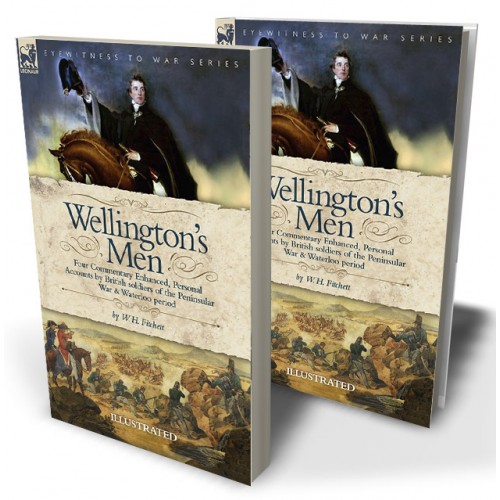
Wellington’s Men - Four Commentary Enhanced, Personal Accounts by British soldiers of the Peninsular War and Waterloo period
Qty:     - OR -   Add to Wish List

Author(s): W. H. Fitchett
Date Published: 2026/10
Page Count: 292
Softcover ISBN-13: 978-1-918436-77-8
Hardcover ISBN-13: 978-1-918436-76-1

British soldiers at war with Napoleon-their own words

This anthology contains four vital, first-hand accounts from British soldiers who fought in the Napoleonic Wars -specifically in the Peninsular War which was fought in Portugal, Spain and in the Pyrenees region of southern France between 1808-14. One account takes the reader into one of the most renowned engagements of all time; The Battle of Waterloo of 1815. This was the reality of 19th-century warfare through the eyes of the men on the ground and told in their own words. Fitchett provides introductory remarks and very useful contextual commentary to each account, but allows the authentic voices of these four especially selected men of  different ranks to recount their own perspectives- making this book an entertaining and useful guide for anyone interested in this subject or needing information for study. Captain John Kincaid  was a gallant, dashing and 'devil- may- care' junior officer of the famous green- jacketed 95th Rifles, made famous in modern popular fiction. His witty style brought him success as an author of two books. By way of contrast the illiterate Benjamin Harris, who served in the same regiment as a private soldier, recounted his story to an officer who turned it into the abiding written word. He tells of  gruelling marches, starvation, and hard warfare fought by these elite, sharp-shooting skirmishers. Sergeant James Anton, serving with the 42nd (Highland) Regiment of Foot (The Black Watch).served in campaigns across Iberia and the Pyrenees. The 42nd were heavily engaged before Waterloo at Quatre Bras, where it was caught in the open fields by French lancers and, in consequence, suffered severely. Captain Cavalié Mercer presents the view of an  officer who commanded a troop of Royal Horse Artillery during the Battle of Waterloo. His well known and regarded testimony details the action of his gunners as they fired into the faces of Napoleon's charging cavalry amid the noise and chaos  of the battlefield. 

Leonaur editions are newly typeset and are not facsimiles; each title is available in softcover and hardback with dustjacket.


Kincaid shared in all the bloody fights of the Peninsula, from Sabugal to Toulouse. His descriptions of these fights are hasty and planless; they give no hint of the strategy behind them or of the results which followed them. But they are always vivid, racy, and rich in personal incident, and we give in this chapter some transcripts from them.
Sabugal was the last combat fought on Portuguese soil in Massena’s sullen retreat from the lines of Torres Vedras. Massena was never so dangerous as in retreat, and Ney, with all his fiery valour, commanded his rearguard. The French, too, were in a mood of almost reckless savagery, and they greatly exceeded in numbers the force pursuing them. It may be imagined, then, what an incessant splutter of fierce and angry skirmishes raged betwixt Wellington’s advance-guard and the French rear. Yet the veterans on both sides maintained a singularly cool and business-like attitude towards each other, an attitude not unflavoured with gleams of unprofessional friendliness.
Thus, as the French were falling back after the disastrous fight at Redinha, night fell while the skirmishers of the Rifles were still eagerly pressing on the tired French rearguard. The officer commanding the French suddenly held up his sword in the grey dusk with a white handkerchief tied to it. An officer of the Rifles went forward to parley, when the Frenchman explained that he thought both sides needed a rest after a hard day’s work. To this the officers of the Rifles cheerfully agreed, and politely invited the Frenchman and his subalterns to share their rations. This proposal was accepted; the French and English officers sat merrily round a common fire, and shared a common meal; then parted, and before daybreak became pursuers and pursued again!
Sabugal was described by Wellington himself as “one of the most glorious actions British troops ever engaged in”; but it was little better than a gallant blunder. The day was one of drifting fog and blinding rain. Wellington’s plan was with three divisions—a force 10,000 strong—to envelop and crush Massena’s left wing, commanded by Regnier, but Erskine, who commanded the Light Division, failed to understand his orders, wandered off with his cavalry in the fog, and left Beckwith with four companies of the Rifles and the 43rd lying sheltered near the ford across the Coa. When Wellington’s general attack was developed, Beckwith was to cross the river and attack.
A staff officer stumbled upon him early in the day, before the other troops had moved, and demanded, with a note of anger in his voice, why he did not attack? Beckwith instantly led his men across the stream, and with one bayonet battalion and four companies of Rifles, proceeded to attack 12,000 French infantry supported by cavalry and guns! And in a combat so strange, against chances so apparently hopeless, the handful of British won!
You may also like