PAYMENT OPTIONS

​

Forthcoming titles

(Book titles are subject to change)

Air War: East Africa WW1

Raf Russia, 1940

The Asc In Africa

South African Gunners

The Supernatural Ludwig Tieck

Wellingtons Men

Shuttle Bury Cobb & Danby Croker

King William’s War

The Supernatural Jerome K. Jerome


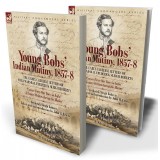
Young Bobs' Indian Mutiny, 1857-8 - The early career and letters of Field Marshal Frederick Sleigh Roberts

enlarge Click on image to enlarge
enlarge Mouse over the image to zoom in
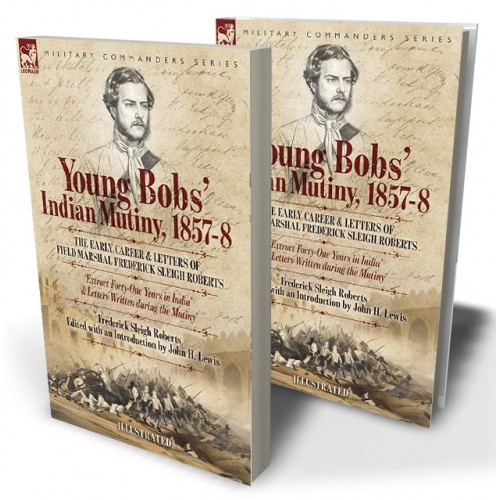
Young Bobs' Indian Mutiny, 1857-8 - The early career and letters of Field Marshal Frederick Sleigh Roberts
Qty:     - OR -   Add to Wish List

Author(s): Frederick Sleigh Roberts & John H. Lewis
Date Published: 2026/10
Page Count: 304
Softcover ISBN-13: 978-1-918436-99-0
Hardcover ISBN-13: 978-1-918436-98-3

'Extract Forty-one Years in India' and' The Letters Written during the Mutiny'

Fred Roberts' arduous and thrilling first campaign in his own words and letters

Long before Field Marshal Frederick Sleigh Roberts ( 1st Earl Roberts of Kandahar) reach the highest rank in the British Army, he typically began his military career as a subaltern and it is this action filled period of his life that forms the content of this book. Roberts' letters home, originally published separately, have been threaded into  this narrative in their chronological place. Born in 1832, the son of a general, in Cawnpore, India, Roberts was sent to England to complete his education. He attended Eton College, followed  by the military academies at Sandhurst and Addiscombe. 1851 saw him return to India as a Second- Lieutenant in the prestigious Bengal Horse Artillery, 'The Red Men'. When the rebellion erupted in May 1857, Roberts was a staff officer serving with the Peshawar- based Punjab Movable Column. By July he was engaged at the siege, assault and fall of Delhi where he was wounded. He joined the column to relieve the besieged British residency at Lucknow under Sir Colin Campbell, taking part in fierce street fighting. In early 1858 ,at the Battle of Khodagunge, he won the Victoria Cross. In March, he took part in his final action of this period, at Kursi, during the pursuit of retreating mutineers. Two months later, ill and exhausted he boarded ship to sail back to England to recuperate. In later life, Roberts wrote his successful autobiography, and it is from this expansive account of his long career which led to his becoming Commander in Chief, that this Leonaur edition is drawn. A riveting read-highly recommended. Contains illustrations some of which did not feature in the original publications.

Leonaur editions are newly typeset and are not facsimiles; each title is available in softcover and hardback with dustjacket.


We moved on under a very heavy fire until we reached an enclosure the wall of which was lined with the enemy. The troops stopped short, when Chamberlain, seeing that they hesitated, called upon them to follow him, and gave them a splendid example by jumping his horse over the wall. The men did follow him, and Chamberlain got a ball in his shoulder.
We had great difficulty in driving the enemy back; they contested every inch of the ground, the many serais and walled gardens affording them admirable cover; but our troops were not to be withstood; position after position was carried until we found ourselves in sight of the Lahore gate and close up to the walls of the city. In our eagerness to drive the enemy back we had, however, come too far.
It was impossible to remain where we were. Musketry from the walls and grape from the heavy guns mounted on the Mori and other bastions committed terrible havoc. Men were falling on all sides, but the getting back was hazardous to the last degree. Numerous as the enemy were, they had not the courage to stand against us as long as we advanced, but the first sign of retreat was the signal for them to leave their shelter and press us the whole way to camp.
When the retirement commenced, I was with the two advanced guns in action on the Grand Trunk Road. The subaltern in charge was severely wounded, and almost at the same moment one of his sergeants, a smart, handsome fellow, fell, shot through the leg. Seeing some men carrying him into a hut at the side of the road, I shouted: ‘Don’t put him there; he will be left behind; get a doolie for him, or put him on the limber.’ But what with the incessant fire from the enemy’s guns, the bursting of shells, the crashing of shot through the branches of the trees, and all the din and hubbub of battle, I could not have been heard, for the poor fellow with another wounded man was left in the hut, and both were murdered by the mutineers.
So many of the men with the two guns were hors de combat, and the horses were so unsteady (several of them being wounded), that there was great difficulty in limbering up, and I was helping the drivers to keep the horses quiet, when I suddenly felt a tremendous blow on my back which made me faint and sick, and I was afraid I should not be able to remain on my horse. The powerless feeling, however, passed off, and I managed to stick on until I got back to camp.
I had been hit close to the spine by a bullet, and the wound would probably have been fatal but for the fact that a leather pouch for caps, which I usually wore in front near my pistol, had somehow slipped round to the back; the bullet passed through this before entering my body, and was thus prevented from penetrating very deep.
The enemy followed us closely right up to our piquets, and but for the steadiness of the retirement our casualties must have been even more numerous than they were. As it was, they amounted to 15 men killed, 16 officers and 177 men wounded, and 2 men missing.
The enemy’s loss was estimated at 1,000. For hours they were soon carrying the dead in carts back to the city.
You may also like