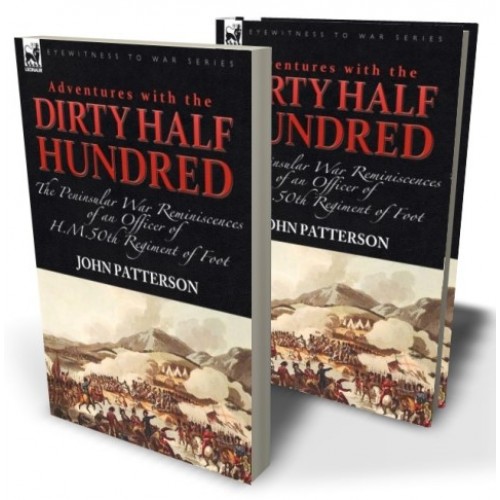
The 'Dirty Half Hundred'—the 50th—won their nickname not from a propensity for unsanitary habits, but from their black facing colour on cuffs and collars which would, when rubbed onto sweating faces, transform the soldiers to the appearance of chimney sweeps. Captain Patterson's adventures are written in a companionable, good natured style which leads the reader through the Peninsular War towards the Pyrenees and Southern France Campaign. This account is filled with much essential information of the campaign and the battlefields as well as entertaining anecdotes of the authors own experiences and those of his soldiers and comrades. An essential addition to the Napoleonic library of every enthusiast. Available in soft cover or hard back with dust jacket.
When the latter, in a compact mass, arrived sufficiently up the hill, now bristled with bayonets, the Black Cuffs poured in a well directed volley upon the dense array. Then, cheering loudly, and led on by its gallant chief, the whole regiment rushed forward to the charge, penetrated the formidable columns, and carried all before it. The confusion into which the panic-struck Frenchmen were thrown it would be difficult to express. No longer able to withstand the British steel, Laborde and his Invincibles made a headlong retreat, and never looked behind them till they reached the forest and vineyards in the rear.<br>
As far as the eye could reach over the well planted valley, and across the open country lying beyond the forest, the fugitives were running in wild disorder, their white sheepskin knapsacks discernible among the wood far distant. There were, however, many resolute fellows, who, in retiring, took cover behind the hedgerows, saluting us with parting volleys, which did considerable execution amongst our advancing troops. At length, even this remnant of the vanquished foe, dispersed and broken in piece-meal, betook themselves to flight in every quarter of the field.<br>
The ground was thickly strewed with muskets, side arms, bayonets, accoutrements, and well-filled knapsacks, all of which had been hastily flung away as dangerous incumbrances. Several of the packs contained various articles of plunder, including plate in many shapes and forms, which they had robbed from the unfortunate Portuguese. Books of songs, romances, and other commodities of a similar kind, were scattered about in all directions; and many a tender billet-doux lay open to the profane gaze and the laughing comments of the vulgar multitude. It was amusing, after all was over, to see the strange medley of curiosities, that had, doubtless, with much pains, been collected by those who lately owned them; and it was with no very nice feelings that a general inspection of the rarities took place, as soon as the defeated army had left the field.<br>
While we were pursuing our opponents, the 20th Light Dragoons, led on by Colonel Taylor, galloped furiously past us, in order to put a finishing stroke to the business, by completing anything that the infantry might have left undone. The horsemen, unsupported, charging the enemy with impetuosity, and rashly going too far, were involved in a difficulty of which, in their eagerness to overtake the stragglers, they had never thought; for, getting entangled among the trees and vineyards, they could do but little service, and suffered a loss of nearly half their number: their brave commander being also one of those who fell in that desperate onset.<br>
The 43rd regiment was very much cut up, being, while employed in skirmishing, considerably exposed. I noticed at least a subdivision of their men lying killed in a deep gulley or trench, as they fell over each other, from a raking discharge of round or grape shot.<br>
The 50th lost a great proportion of rank and file, which chiefly arose from the fire of the French light troops, while covering their column, and during their retreat Major Charles Hill and Lieutenant J. N. Wilson were wounded, and Captain A. G. Coote killed.<br>
Upon the bleak surface of the hill, from which the regiment had charged Laborde, we bivouacked that night, and reposed our weary limbs. Although the air was cold, and our situation comfortless, yet, from extreme fatigue, we rested perhaps more soundly than the pampered alderman on his downy couch. A windmill on the summit afforded excellent quarters for the colonel and his personal staff, while the other officers, less fortunate, crouched together, shivering outside its base.<br>
The 50th took a standard pole and box, which were borne by a serjeant between the colours, as a trophy, during the succeeding campaigns. The French, instead of colours, display a small brass eagle, screwed to a square box of the same metal, both of which are attached to a pole or staff. This eagle is seldom exhibited in the heat of action, the staff being carried as a rallying point, in the same way, and for the same object as our banners.

 your wishlist
 your account


 Click on image to enlarge
 Mouse over the image to zoom in