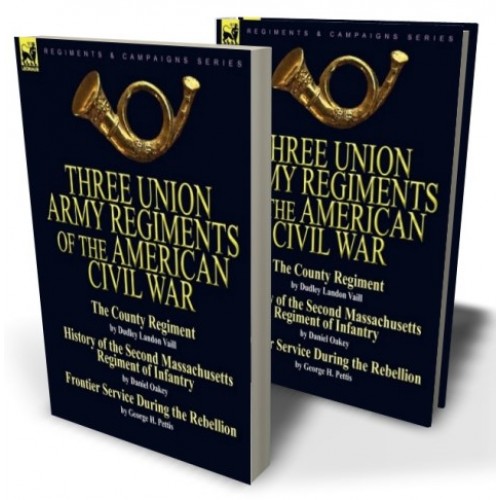
The County Regiment by Dudley Landon Vaill History of the Second Massachusetts Regiment of Infantry by Daniel Oakey Frontier Service During the Rebellion by George H. Pettis
Three regiments of men in blue
Fortunately, so momentous an event in a young nation’s history as the great civil war between the states guaranteed that posterity would be left a considerable volume of histories of the campaigns and units that took part, together with the personal wartime experiences of many of its participants. Rich though this resource is, it is also the case that many of these accounts are comparatively short in length and so are unlikely to achieve individual re-publication in modern times. The Leonaur editors are pleased to remedy this in the case of these three unit histories brought together in one special good value volume. The first account follows the fortunes of the 2nd Connecticut Regiment of Heavy Artillery. The second, written by a captain of the regiment, chronicles the war of the Second Massachusetts whilst the third concerns the doings of the First Infantry, California Volunteers as it campaigned in the wild south west. Available in soft cover and hard cover with dust jacket.
The history of the Second Connecticut gives a detailed account of its movement, first against a stone wall in front which after some opposition was abandoned by the enemy, who then:<br>
. . . .attempted to rally behind another fence a little further back, but after a moment or two gave it up and ‘retired.’ Not only in front of our regiment, but all along as far as the eye could reach, both to the right and left, were they flying over the uneven country in precisely the same kind of disorder that we had exhibited in the morning. The shouts and screams of victory mingled with the roar of the firing, and never was heard ‘so musical a discord, such sweet thunder.’ The sight of so many rebel heels made it a very easy thing to be brave, and the Union troops pressed on, utterly regardless of the grape and canister which to the last moment the enemy flung behind him.<br>
It would not have been well for them to have fired too much if they had had ever so good a chance, for they would have been no more likely to hit our men than their own, who were our prisoners and scattered in squads of twenty, squads of ten, and squads of one, all over the vast field. At one time they made a determined stand along a ridge in front of our brigade.<br>
A breastwork of rails was thrown together, colours planted, a nucleus made, and both flanks grew longer and longer with wonderful rapidity. It was evident that they were driving back their men to this line without regard to regiment or organization of any kind. This could be plainly seen from the adjacent and similar ridge over which we were moving,—the pursuers being in quite as much disorder (so far as organizations were concerned) as the pursued. That growing line began to look ugly and somewhat quenched the ardour of the chase.<br>
It began to be a question in many minds whether it would not be a point of wisdom ‘to survey the vantage of the ground’ before getting much further. But just as we descended into the intervening hollow, a body of cavalry, not large but compact, was seen scouring along the fields to our right and front like a whirlwind directly toward the left flank of that formidable line on the hill. When we reached the top there was no enemy there! They had moved on and the cavalry after them.<br>
Thus the chase was continued, from position to position, for miles and miles, for hours and hours, until darkness closed in and every regiment went into camp on the identical ground it had left in such haste in the morning. Every man tied his shelter tent to the very same old stakes, and in half an hour coffee was boiling and salt pork sputtering over thousands of camp fires. Civil life may furnish better fare than the army at Cedar Creek had that night, but not better appetites; for it must be borne in mind that many had gone into the fight directly from their beds and had eaten nothing for twenty-four hours.<br>
Men from every company started out the first thing after reaching camp to look for our dead and wounded, many of whom lay not fifty rods off. The slightly wounded who had not got away had been taken prisoners and sent at once toward Richmond—while the severely wounded had lain all day on the ground near where they were hit while the tide of battle ebbed and flowed over them.<br>
Some of the mortally wounded were just able to greet their returning comrades, hear the news of victory, and send a last message to their friends before expiring. Corporal Charles M. Burr was shot above the ankle just after the battalion had risen up and started to retreat. Both bones of his leg were shattered and he had to be left. In a few minutes the rebel battalion which I have already mentioned came directly over him in pursuit, and was soon out of his sight. Then being alone for a short time he pulled off the boot from his sound leg, put his watch and money into it and put it on again.<br>
Next a merciful rebel lieutenant came and tied a handkerchief around his leg, stanching the blood. Next came the noble army of stragglers and bummers with the question, ‘Hello, Yank, have you got any Yankee notions about you?’ and at the same time thrusting their hands into every pocket. They captured a little money and small traps, but seeing one boot was spoiled they did not meddle with the other. Next came wagons, picking up muskets and accoutrements which lay thick all over the ground.<br>
Then came ambulances and picked up the rebel wounded but left ours. Then came a citizen of the Confederacy asking many questions, and then came three boys who gave him water. And thus the day wore along until the middle of the afternoon when the tide of travel began to turn. The noble army of stragglers and bummers led the advance—then the roar of battle grew nearer and louder and more general, then came galloping officers and all kinds of wagons, then a brass twelve-pounder swung round close to him, unlimbered, fired one shot, and whipped off again—then came the routed infantry, artillery, and cavalry, all mixed together, all on a full run, and strewing the ground with muskets and equipments.<br>
Then came the shouting ‘boys in blue,’ and in a few minutes Pat Birmingham came up and said: ‘Well, Charley, I’m glad to find you alive. I didn’t expect it. We’re back again in the old camp, and the Johnnies are whipped all to pieces.’<br>
The victory was as complete and satisfying as it was spectacular; the enemy was at last so thoroughly beaten that a dangerous attitude could not be taken again. It was a fitting close for Sheridan’s famous campaign in the Shenandoah Valley.

 your wishlist
 your account


 Click on image to enlarge
 Mouse over the image to zoom in