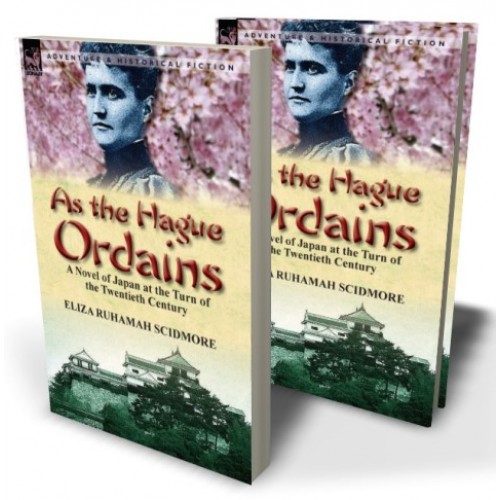
The author of this novel wrote just one work of fiction. She was, however, a remarkable and highly creative person in other ways. An American, she was highly regarded as a writer, photographer and geographer. Widely travelled, she became the first woman board member of the National Geographic Society. Eliza Scidmore was fortunate in that her brother was a career diplomat operating principally in the Far East. She often accompanied him on his travels and this gave her access to regions that would have been very difficult for ordinary travellers to reach. She was an enthusiastic writer and books on Alaska, Japan, China, Java and India followed in rapid succession. This novel, ‘As the Hague Ordains,’ written in 1907, is set in Japan in the period of the Russo-Japanese War which was fought from 1904-5 and which came about as a consequence of the imperial ambitions of both Russia and Japan as they collided over the dominance of Korea and Manchuria. It tells of the adventures of the wife of a wounded Russian prisoner, Vladimir, who was captured while on a scouting patrol with his Cossacks. Unable to bear their separation she journeys to be at his side in the prisoners’ hospital at Matsuyama.
Leonaur editions are newly typeset and are not facsimiles; each title is available in softcover and hardback with dustjacket.
I shut my eyes, and held the side of the jinrikisha tightly, as we coursed through a few streets, past a field and some bare spaces, and stopped at an open gate, where sentries stood with muskets and bandoliers. This was the first real soldier of the victorious army on actual duty that I had seen. He was a hard-faced old peasant in a patched and faded khaki uniform. The vice-consul presented his card and my permit, spoke amiably in Japanese, and the sentry grunted, “Huh!” Another old trooper took the cards, fingered them, showed them to his mates at the guard-house door, and slowly took his bow-legged way across the bare earthen court to a row of wooden warehouses or barrack buildings. All was new and raw, and carpenters were at work on other new buildings, at which the vice-consul lifted his shoulders. “More barracks. More barracks. Mon Dieu, again more prisoners!”<br>
It was a strange experience to me, this standing outside the gates, with rustics in the road, and uniformed rustics within the gate, staring at me stolidly, woodenly, like so many ruminant cattle—in the same Japan where every gate used to swing wide open for us, every head to bend low, politely, respectfully, when we touched the circle of the government.<br>
“But is it possible that these people do not know that you are the vice-consul of France? Have you not been here before? And did we not telegraph the coming in advance?”<br>
“Oh, yes. But be tranquil, madame, a little of patience. These are the conquerors, you know. And since the Oriental cannot impress us by making a grand tour of many apartments, we shall arrive at the sensation of awe by waiting in humility at the outer entrance.”<br>
The bow-legged peasant in uniform returned towards the gate, stopped at a distance, and beckoned to us with his fingers to advance—quite as you summon a porter at a railway station. I was fortified then for anything that might happen in this changed Japan, my heart beating to suffocation, and my face burning with colour. We went along an endless covered piazza to the door of the chancery, a bare room, where clerks without coats wrote at many wooden tables, and the air was that of a furnace between thin wooden walls scorching in the afternoon sun. A young Japanese ran forward, with head erect, in a bold, familiar manner, and took the vice-consul by the hand, to my utter amazement, and began stuttering a jargon of bad French. The vice-consul presented him.<br>
“Ah, the companion of one of the prisoners!” said the youth, who it seems is the official interpreter, thrusting his hand out from where he stood a few paces from me. The tactful Frenchman moved forward, seized the hand, and effusively shook it a second time, and the blood that had been beating in my face so fiercely, ebbed back and back, and a chill struck my heart.<br>
“She must have a permit, of course,” said this recently uniformed soshi, staring at me with a sangfroid that far passed the plane of equality.
“She has one, which the guardian at the gate has brought here,” said my French ally. “It is from the Minister of War, and I have yesterday telegraphed explanations to the commandant, and asked that, under the extreme circumstances, he will permit her to visit her husband immediately upon her arrival. Has he not informed the hospital?”<br>
“Ah! perhaps. Yes, truly, he has. It is here,” said the young autocrat, picking up the most prominent written sheet on his table, and with it my permit sent in from the gate. “She may go now,” said the lordly one, and he almost waved us from his presence, but not before the vice-consul had recovered my official papers.<br>
“Have the goodness, please, to send someone to M. le Colonel to announce that Madame has arrived at Matsuyama and will soon come to him. It is not good for him to have too strong a shock,” said my brave man of France.<br>
While a messenger in mule slippers went ahead, we followed slowly, my considerate Frenchman stopping now and then for a few moments, for I was gasping rather than breathing, a mist filled my eyes, and stumbling, I put out my other hand to steady myself against the walls and posts. I saw dimly white-robed hospital patients standing here and there, saluting; I toiled up a little slope of floor, the vice-consul lifted a white sheet of a curtain, released his arm, and dropped the white cloth between us.<br>
A muffled, crying sob: “Sophia! Sophia!” and I flung myself by the wooden hospital cot I had come so far to reach. A head, shapeless with a swathing of white bandages, lay there; and from it looked the dear, dark eyes, but—shadowed with such depths of unutterable sadness, of woe unspeakable, the mute record of pain endured, and of a noble soul’s humiliation, an agony more excruciating than any mere physical nerve vibrations.

 your wishlist
 your account


 Click on image to enlarge
 Mouse over the image to zoom in